Why the Moon rises about fifty minutes later each night
The Moon gains roughly 50 minutes on the Sun every day — but the range is 20 minutes to over an hour, and the reason decides when a harvest moon happens.
Stand outside at the same time on two consecutive nights and the Moon has moved. Not much — about 13° east against the stars — but the consequence on a clock is large, because the sky turns 15° every hour. Thirteen degrees of extra travel is roughly 50 minutes of extra waiting.
That is the whole mechanism: a lunar day, the interval from one moonrise to the next, is about 24 hours 50 minutes. A solar day is 24 hours. The Moon is late every night, by roughly the same amount, which is why its schedule drifts out of the working day within two weeks.
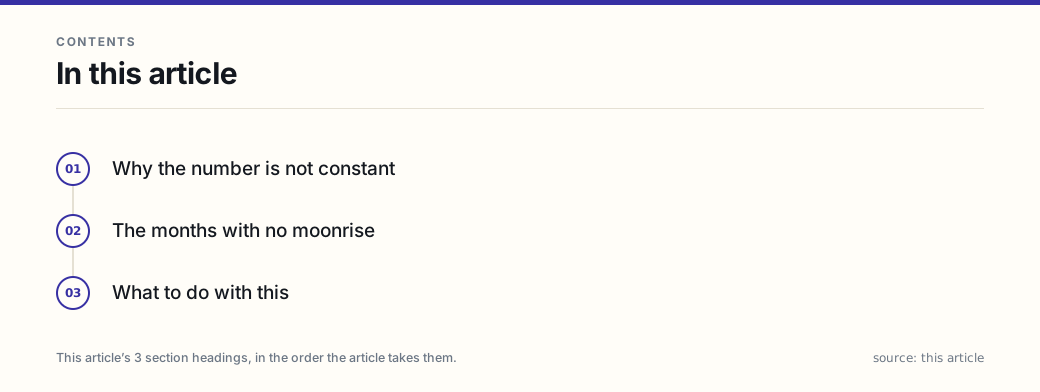
Why the number is not constant
If the delay were exactly 50 minutes, moonrise times would be easy. It is not, and the reason is the angle of the Moon’s path to your horizon.
The Moon rises at a point on the horizon, and the time it takes to climb the same 13° depends on how steeply its path rises there. When the ecliptic stands nearly upright against the horizon — evenings in autumn at northern latitudes, mornings in spring — the Moon gains altitude fast and the delay can shrink to 20 minutes. When the ecliptic lies nearly flat — spring evenings, autumn mornings — the Moon crawls sideways along the horizon and the delay can reach 70–80 minutes.
That single fact is the entire basis of the harvest moon, and it is why the effect is strongest at high latitude. Here is the sequence computed by this site’s own engine for 45°N around the September 2026 full moon:
| Night | Moonrise | Delay |
|---|---|---|
| September 24 | 16:54 | — |
| September 25 | 17:12 | 18 min |
| September 26 | 17:31 | 19 min |
| September 27 | 17:51 | 20 min |
| September 28 | 18:14 | 23 min |
| September 29 | 18:43 | 29 min |
Six evenings, and the Moon rises within 85 minutes of the same clock time on all of them — instead of the four hours the 50-minute average would predict. That is the phenomenon the name describes: several nights in a row when the Moon is up early in the evening, which historically meant light to bring in a harvest.
A month later at the same latitude the same calculation gives delays of 23, 27, 34, 46 and 59 minutes — the effect is real but already decaying.
The months with no moonrise
The 50-minute drift has a second consequence that most tables hide. If a lunar day is 24h 50m, then the rise that happens at 23:40 one evening happens at 00:30 the next morning — and the calendar date in between contains no moonrise at all.
This is not rare. It happens once or twice a month, and it is a hard consequence of 29.53 days not dividing 24 hours. A table that shows a rise on every date is either using a different day boundary or filling the gap with interpolation. The moonrise table on this site prints “none” and says so, because the alternative is a number that looks like every other number.
What to do with this
Three practical consequences, no mysticism:
- Plan by the phase, not the clock. If you want to see the Moon in the evening, the week after full moon puts it up early; the week before, it rises late and is up in the morning instead.
- A full moon ruins a meteor shower. Not because of anything mystical: it is the brightest object in the night sky, and its light is enough to wash out all but the brightest meteors. The meteor shower page treats this as the central planning problem.
- The drift is why eclipse seasons exist. New moon is the only phase at which a solar eclipse can happen, and it walks around the calendar at 29.53-day steps, which is why eclipses arrive in seasons rather than monthly.
Times above are computed for 45°N on the prime meridian and are illustrative of the mechanism; your own latitude shifts the numbers. Use the city table for a real place.
Frequently asked questions
- Why is the delay not exactly 50 minutes every day?
- Because the Moon's daily gain on the Sun depends on the angle its path makes with your horizon. Near the equinoxes, when the Moon is in the part of its orbit that rises steeply at your latitude, the gap shrinks; in spring at northern latitudes it widens toward 70–80 minutes. The 50-minute figure is an average over a month.
- Why does a full moon rise at sunset?
- A full moon is opposite the Sun, so it rises as the Sun sets and sets as the Sun rises. That is not a coincidence of scheduling but the definition of full: elongation 180° means the Moon is on the far side of Earth from the Sun, which is precisely when it is above the horizon all night.
- Does the Moon rise at the same time everywhere?
- No. The rise time depends on latitude and longitude, so a city 450 km west of another sees the same rise roughly half an hour later on the clock — but its clock may be in a different time zone, which cancels part or all of the shift. Latitude changes the shape of the Moon's path and therefore the delay between successive nights.
Sources
Each source is a primary or official reference, checked before publication. Links open the original.
- U.S. Naval Observatory, Astronomical Applications Department — rise/set tables used to check this site's computed moonrise times to within half a minute (aa.usno.navy.mil/data/RS_OneDay)
- Meeus, Astronomical Algorithms, 2nd edition, chapter 15 — the rise/set condition for a body whose declination changes during the day, h₀ = 0.7275·π − 34′
- NASA Science — Moon: the 27.32-day sidereal period and the 29.53-day synodic period whose difference produces the daily delay (science.nasa.gov/moon/)
- Royal Astronomical Society / HM Nautical Almanac Office, and the Maine Farmers' Almanac tradition — the harvest moon as the full moon nearest the September equinox, and the short successive rise delays that name refers to