The Moon is drifting away at 3.8 centimeters a year
Tidal friction is transferring Earth's spin to the Moon's orbit. Laser reflectors left by Apollo measure the drift, and the day is getting longer.
The Moon is leaving. Not dramatically, and not soon, but measurably: 3.8 centimeters per year, which is about the rate your fingernails grow. Over the 4.5 billion years of its existence that adds up to a Moon that started roughly 20,000 km away — around 5% of today’s distance — and is now 384,400 km out.
The measurement is one of the most direct in all of astronomy. Apollo 11, 14 and 15 left retroreflector arrays on the lunar surface between 1969 and 1971; the Soviet Lunokhod missions left two more. Observatories fire laser pulses at them and count the photons that come back, timing the round trip to picoseconds. That gives the Earth–Moon distance to a few millimeters, and averaging over five decades of data gives the rate.
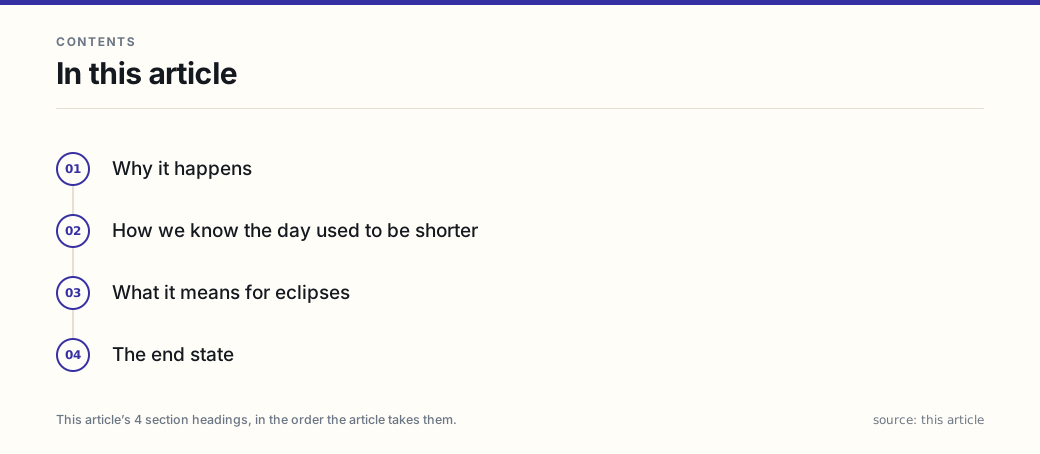
Why it happens
Earth spins faster than the Moon orbits. One rotation takes 24 hours; one orbit takes 27.3 days. So the tidal bulge that Earth raises on itself — the two humps of ocean, and of solid rock, pulled up by the Moon — is dragged ahead of the Earth–Moon line by the planet’s rotation.
That offset bulge pulls on the Moon. Its gravity on the leading bulge gives the Moon a small forward tug, which adds energy to the orbit and pushes the Moon further out. The reaction on Earth is a braking torque that slows the rotation.
Nothing is created: angular momentum is conserved, and it moves from Earth’s spin to the Moon’s orbit. The Moon’s orbital period grows, and the Earth’s day lengthens. Measured values:
| Quantity | Rate | How measured |
|---|---|---|
| Earth–Moon distance | +3.8 cm per year | Lunar laser ranging, 1969–present |
| Length of the day | +1.8 ms per century | LLR plus the tidal model, cross-checked against ancient eclipses |
| Moon’s orbital period | + about 0.1 s per century | Derived from the same solution |
How we know the day used to be shorter
The lengthening day is not only measured going forward. Ancient eclipse records — Babylonian, Greek, Chinese, medieval European — give the date and place of totality, and the predicted path depends on how much the Earth had rotated by then. Run the clock backwards with today’s rate and the shadows land in the wrong country; run it with the longer history of a slowing Earth and they line up.
That is how the 1.8 ms per century figure gets independent confirmation: the Earth’s rotation is the only clock in the problem, and written records of eclipses are how it gets checked.
The accumulated effect is why your clock is not the sky. The difference between dynamical time and universal time — ΔT — is about 69 seconds in 2026 precisely because the planet has slowed since the second was defined.
What it means for eclipses
Total solar eclipses exist because the Moon’s angular diameter happens to match the Sun’s. That match is temporary. The Sun’s apparent diameter is shrinking slowly, and the Moon’s is shrinking faster as it recedes.
Published estimates put the end of total solar eclipses at roughly 600 million years from now: after that the Moon will always be too small in the sky to cover the Sun, and annular eclipses will be the best available. Nothing in the 2026–2035 catalog is affected, and no reader will be.
The end state
The process stops when Earth’s rotation and the Moon’s orbital period match. At that point the Moon hangs over one longitude permanently, and Earth’s day equals the lunar month — the same relationship Pluto and Charon already have, with both bodies mutually locked.
The calculated endpoint is a Moon about 1.6 times farther away and a day around 47 current days long. It will not be reached: the Sun’s evolution intervenes in about five billion years. The tidal mechanism that produces this is the same one that makes the Moon rise later every night, which is visible on any clear evening rather than in a billion years.
Recession rate and day-length figures are the published laser-ranging solution; the endpoint estimates carry the uncertainty of a model extrapolated over billions of years.
Frequently asked questions
- How is the drift measured?
- Lunar laser ranging. Apollo 11, 14 and 15 left retroreflector arrays on the Moon in 1969–71, and the Soviets left two more on Lunokhod rovers. Observatories fire short laser pulses at them and time the return to picoseconds, which gives the Earth–Moon distance to a few millimeters. Averaged over five decades, the rate is 3.8 cm per year.
- Will the Moon ever leave?
- Not before the Sun does. The recession slows as the orbit widens, and the process ends when Earth's rotation and the Moon's orbital period become equal — a mutual tidal lock with the Moon about 1.6 times farther away and a day roughly 47 of our current days long. The Sun is expected to become a red giant in about five billion years, well before that state is reached.
- Does this mean the day is getting longer?
- Yes, by about 1.8 milliseconds per century. Angular momentum is conserved: what the Moon's orbit gains in distance, Earth's rotation loses in speed. It is far too small to notice in a lifetime but it accumulates, which is why the length of the day recorded by ancient eclipse observations is measurably shorter than today's.
- Was the Moon ever close enough to fill the sky?
- Yes. The leading model for the Moon's origin has it forming from debris a few tens of thousands of kilometers away, which would have made it appear many times larger than it does now. Tidal recession has been widening the orbit ever since, and it will eventually make total solar eclipses impossible.
Sources
Each source is a primary or official reference, checked before publication. Links open the original.
- NASA — Apollo Lunar Retroreflector Arrays and the Lunar Laser Ranging experiment, still operating at McDonald Observatory and Grasse, and the 3.8 cm/year recession rate (science.nasa.gov/moon/)
- Williams, Boggs & Folkner, "The Moon's past and future orbit and the tidal history of the Earth-Moon system" — the laser-ranging solution giving the recession rate and the 1.8 ms/century lengthening of the day (Journal of Geophysical Research / Royal Society proceedings)
- Meeus, Astronomical Algorithms, 2nd edition, chapters 47 and 49 — the lunar and solar theory used here to compute where the Moon is; note that ΔT in this site's engine absorbs the accumulated effect of the lengthening day
- Espenak & Meeus, Five Millennium Canon of Solar Eclipses — the historical record of eclipse timings used to reconstruct the length of the day over two millennia (eclipse.gsfc.nasa.gov)