Blue moon: what the term actually means, and why there are two definitions
A blue moon is either the second full moon in a month or the third in a season of four. Both are in use, they disagree, and neither involves color.
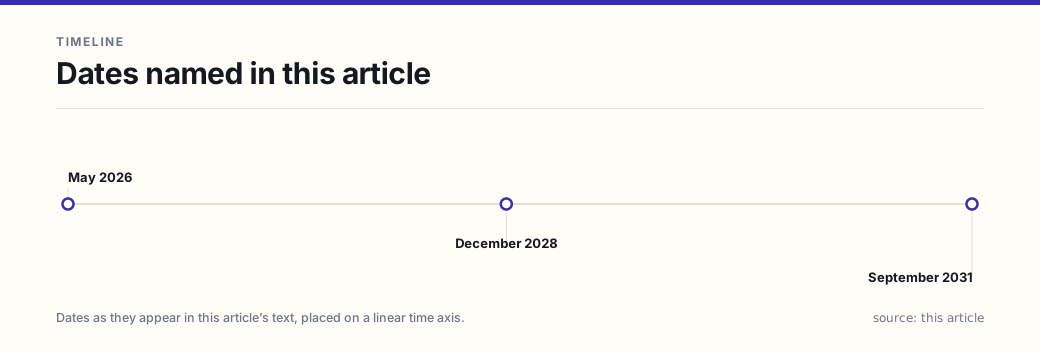
There are two blue moons, they are not the same event, and both are legitimate. This page gives you the dates for each, computed from the same lunar solver used everywhere else on this site, and then explains why the word means two things.
Definition one: the second full moon in a month
This is what most people mean today. A calendar month is 30 or 31 days; a lunation is 29.53 days. Most months fit exactly one full moon. Occasionally one fits two, and the second gets the name.
| Blue moon | Dates | Note |
|---|---|---|
| May 2026 | May 1, May 31 | The May 31 full moon is also the farthest of the year |
| December 2028 | December 2, December 31 | The second falls on New Year’s Eve |
| September 2031 | September 1, September 30 | — |
The gap between them is not regular — 31 months, then 33 — because it depends on where the 29.53-day cycle falls against months of different lengths. On average, about once every 2.7 years.
Definition two: the third full moon in a season of four
This is the older rule, and the one the Maine Farmers’ Almanac used for the names it published. A season normally holds three full moons. When it holds four — which happens because 12 lunations fall 11 days short of a year — the third of them is the blue moon.
Why the third and not the fourth? Because the almanac’s names were tied to dates: the full moon nearest the equinox had to keep its name, and the extra one had to be the one that did not disturb the sequence.
Both rules are internally consistent and they disagree in any given year, sometimes by months. If you are checking a claim, the first question is which definition the claimant is using — and most popular sources do not say.
The arithmetic behind it
Twelve lunations come to 354.37 days. A tropical year is 365.24. The shortfall is 10.87 days, which accumulates: after about two and a half years it adds up to a whole lunation, and a 13th full moon appears inside a calendar year. In 19 years there are 235 lunations and 228 calendar months, an excess of seven — which is why blue moons cluster in a Metonic pattern and why the intervals between them alternate between roughly 2.5 and 3 years.
The same 19-year cycle underlies the rule for when to add a leap month in the Hebrew calendar and the computation of Easter. It is not an astronomical coincidence so much as a statement about how close 19 tropical years and 235 lunations happen to be — within about two hours.
Where the color myth comes from
A blue moon has never meant a blue-coloured Moon, and the phrase “once in a blue moon” predates the calendar definitions by centuries — it meant something that does not happen, and the calendar rule gave it a precise meaning afterwards.
Genuinely blue Moons do occur, and the cause is atmospheric. When the air holds particles slightly smaller than the wavelength of red light, red is scattered out and the transmitted light shifts blue. Volcanic eruptions, large forest fires and dust storms can do it. Krakatoa in 1883 produced blue and green sunsets for months. The Moon after Mount Pinatubo in 1991 was reported blue in some locations for over a year.
The one thing worth checking
If a “blue moon” date matters to you, the check is arithmetic: find the full moon instants for the month. The phase calendar lists them for the coming year, and the phase tool gives the instant for a single date. If two full moons fall inside one calendar month, the definition-one blue moon is real and you can stop there.
Dates computed in UTC; a full moon near midnight can fall in different months in different time zones, which is the one place these dates can legitimately move.
Frequently asked questions
- When is the next blue moon?
- May 31, 2026, by the monthly definition — the second full moon in that calendar month, after May 1. The next one after that is December 31, 2028, then September 30, 2031. By the seasonal definition, which counts the third full moon in a season that contains four, the dates are different again.
- Does the Moon ever actually look blue?
- Rarely, and never because of its phase. A genuinely blue Moon needs particles in the atmosphere of just the right size to scatter red light — volcanic dust, forest-fire smoke or dust storms. It happened after Krakatoa in 1883, after the Canadian forest fires of 1950, and after Mount Pinatubo in 1991. A normal full moon is white, yellow or orange near the horizon.
- Why did the definition change?
- It was a mistake that became a tradition. The older rule, from the Maine Farmers' Almanac, was seasonal: the third full moon in a season with four. An article in Sky & Telescope in 1946 described it incorrectly as the second full moon in a month. A 1980 radio program repeated the error, it spread, and by the 1990s the monthly version was what most people meant. Both are now in circulation.
- How often do blue moons happen?
- About once every 2.7 years on average by the monthly rule. The reason is the mismatch between a 29.53-day lunation and months of 30 or 31 days: 12 lunations come to 354 days, about 11 days short of a year, so every couple of years a 13th full moon lands inside the calendar and one month ends up with two.
Sources
Each source is a primary or official reference, checked before publication. Links open the original.
- Meeus, Astronomical Algorithms, 2nd edition, chapter 49 — the 29.530589-day synodic month and the Metonic relation of 235 lunations to 19 years
- Sky & Telescope — the 1946 James Hugh Pruett article that restated the seasonal rule as a monthly one, and the magazine's later account of how the error spread through the 1980 StarDate radio script
- Maine Farmers' Almanac — the seasonal blue moon definition: the third full moon in a season that contains four
- U.S. Naval Observatory — full moon instants for 2026–2031, against which the blue moon dates on this page were computed (aa.usno.navy.mil)