The Bortle scale: nine grades from pristine to unusable
A one-to-nine judgment of how dark your sky is, anchored to things you can actually see — the Milky Way, zodiacal light, the limiting magnitude.
The Bortle scale is not an instrument reading. It is a description of what a sky looks like, in nine grades, published by John Bortle in Sky & Telescope in 2001 and still the most useful shorthand for “how dark is it where you are”.
It works because each class is anchored to something you can check with your own eyes.
| Class | Sky | Naked-eye limiting magnitude | What you should see |
|---|---|---|---|
| 1 | Excellent dark site | 7.6–8.0 | Zodiacal light obvious; Milky Way casts shadows; airglow visible |
| 2 | Typical truly dark site | 7.1–7.5 | Milky Way highly structured; M33 an easy naked-eye object |
| 3 | Rural sky | 6.6–7.0 | Milky Way complex; some light pollution on the horizon |
| 4 | Rural/suburban transition | 6.1–6.5 | Milky Way still impressive overhead, washed out near the horizon |
| 5 | Suburban sky | 5.6–6.0 | Milky Way weak and patchy overhead; clouds visibly bright |
| 6 | Bright suburban sky | 5.1–5.5 | Milky Way invisible except near the zenith; sky greyish |
| 7 | Suburban/urban transition | 4.6–5.0 | Entire sky has a greyish glow; Milky Way invisible |
| 8 | City sky | 4.1–4.5 | Only the brightest constellations recognisable |
| 9 | Inner-city sky | 4.0 or less | Only the Moon, planets and a few bright stars |
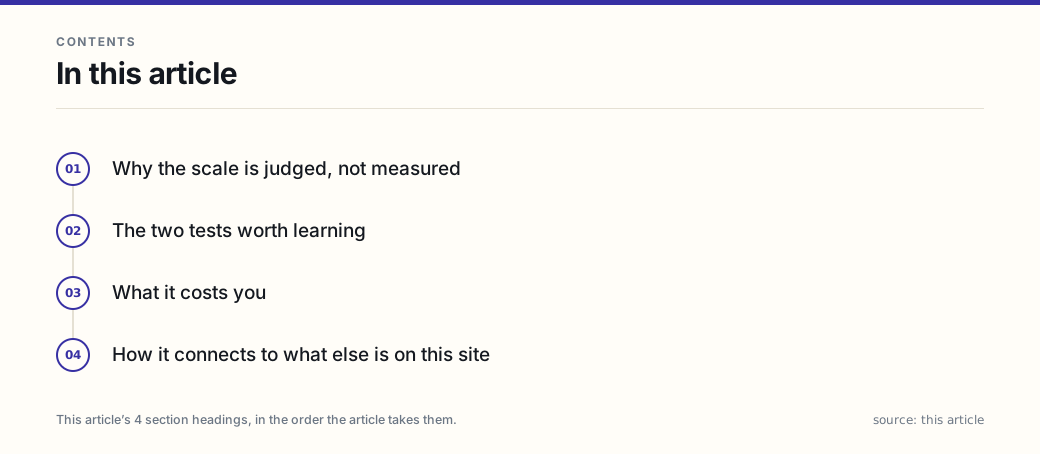
Why the scale is judged, not measured
Sky brightness is measured in magnitudes per square arcsecond, and a modern sky quality meter will give you a number. The Bortle scale predates that being cheap, and it survives because it answers the question people actually have: what will I be able to see?
A reading of 21.5 mag/arcsec² corresponds to roughly class 3 or 4. But two sites with the same reading can differ in what is visible, because the distribution of light matters too: a bright dome on one horizon is a different sky from a uniform glow, even when the average is the same.
The two tests worth learning
The Milky Way test. Find it, and look at what it is doing. Visible all the way to the horizon, with dust lanes and structure = class 1–3. Visible overhead but fading before the horizon = 4. Absent or barely there = 5–6. Not there at all = 7 or worse.
The zodiacal light test. A faint cone of light along the ecliptic, visible after sunset in spring and before sunrise in autumn, from a dark site. If you can see it easily, you are at class 1–3. If you have never seen it, that is a statement about your sky, not about your eyes.
What it costs you
The practical difference between a class 8 sky and a class 3 sky, for a small telescope, is larger than the difference between a 4-inch and a 12-inch telescope. Objects that are invisible from a city — galaxies, nebulae, the outer parts of the Milky Way — become obvious from a dark site with a modest instrument.
That is why the most valuable astronomy purchase is usually fuel, and why the meteor shower advice puts distance from lights ahead of equipment.
How it connects to what else is on this site
Every “when can I see X” question has two halves: whether the object is up, and whether the sky is dark enough. The first half is computable and this site computes it — moonrise, sunrise and twilight all have pages. The second half is geography and cannot be computed from a latitude; the Bortle scale is how you estimate it in the field.
The Moon’s contribution to sky brightness is the one brightening agent that is computable, which is why the phase matters so much when planning: a full moon can add several magnitudes of skyglow, taking a class 2 site to something like class 6 for the hour around it.
The class descriptions are Bortle’s; the limiting magnitudes are the convention he listed and vary between observers. This page makes no claim about light pollution beyond what it does to the sky.
Frequently asked questions
- What is the Bortle scale?
- A nine-point scale published by John Bortle in Sky & Telescope in 2001, describing how dark a night sky is. Class 1 is a pristine site where the Milky Way casts visible shadows; class 9 is an inner-city sky where only the Moon and a handful of planets are visible. Each class lists what you should be able to see, which is what makes it usable without instruments.
- How do I estimate my Bortle class?
- By what is missing. If you cannot see the Milky Way at all, you are at 7 or worse. If you can see it but it looks washed out and has no structure, you are around 5 or 6. If it is obvious and structured overhead but not near the horizon, you are around 4. If it extends to the horizon and casts shadows, you are at 1 or 2. The zodiacal light and the limiting magnitude confirm the estimate.
- How much does each class cost in visible stars?
- Roughly a factor of two to three in the number of stars visible per step toward the city. A class 1 site shows about 4,000 stars to the naked eye; a class 9 site shows perhaps 20. The same telescope at the same magnification will show dramatically different things, which is why a dark site beats a bigger instrument almost every time.
- Does the Bortle scale say anything about my health or the environment?
- No — it is a description of sky brightness. The broader question of what artificial light does to ecology and human sleep is a separate and well-studied field, but this page sticks to the scale, which is about what you can see.
Sources
Each source is a primary or official reference, checked before publication. Links open the original.
- Bortle, John E., "Introducing the Bortle Dark-Sky Scale", Sky & Telescope, February 2001 — the original nine-class description that this table summarizes
- International Dark-Sky Association (DarkSky International) — the sky quality and light-pollution measurements that correspond to each Bortle class, and the finder charts for dark-sky places (darksky.org)
- Falchi et al., "The New World Atlas of Artificial Night Sky Brightness", Science Advances (2016) — the global mapping of artificial skyglow that gives the scale a physical basis
- International Astronomical Union — the limiting-magnitude convention used to describe naked-eye sky brightness (iau.org)